
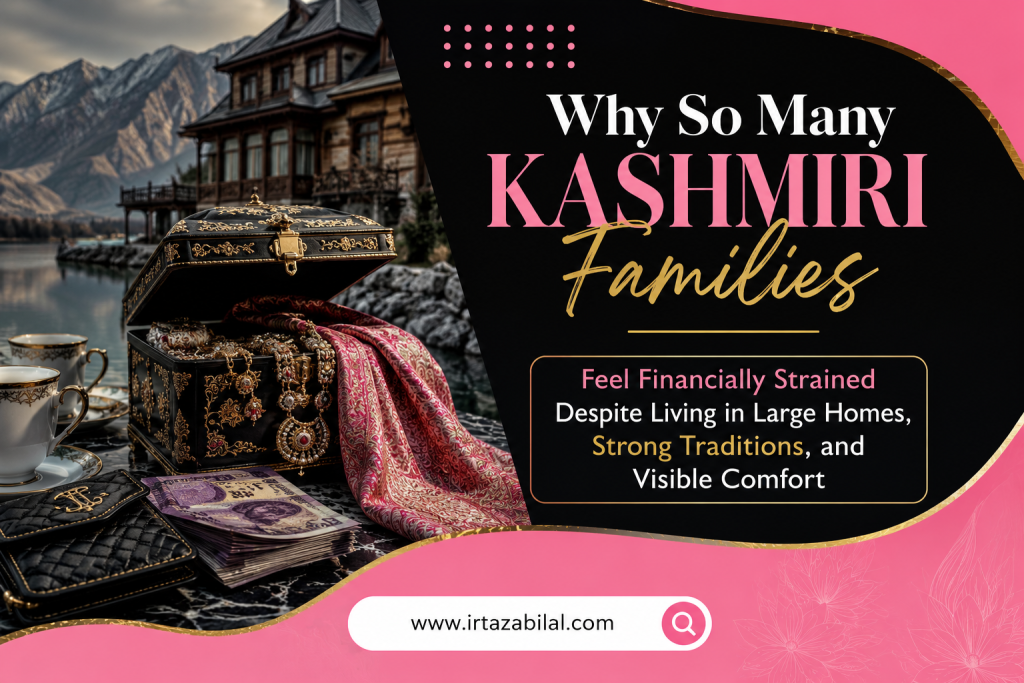
In many parts of Kashmir, it is common to see beautiful, spacious homes standing tall with strong architecture, carved woodwork, and generations of family legacy embedded in every wall. From the outside, these households often appear stable, even prosperous. Yet, behind closed doors, a very different reality is quietly unfolding. Many families describe a persistent feeling of financial pressure, instability, and the constant sense of “not having enough,” even when surrounded by visible assets.
This contradiction raises an important question: how can families living in large homes, often on ancestral land, still feel financially strained in daily life?
The answer is complex, deeply rooted in economic structure, cultural expectations, lifestyle patterns, and changing times. It is not about a lack of assets, but rather a growing imbalance between what families own and what they can actually access in terms of financial liquidity and income stability.
The illusion of wealth: asset-rich but cash-poor households
One of the most overlooked realities is the difference between physical wealth and usable wealth. Many Kashmiri families own large homes, land, or inherited property. On paper, this creates the impression of financial strength. In reality, these assets are often non-liquid, meaning they cannot be easily converted into cash without major trade-offs such as selling ancestral land or breaking family legacy.
This creates a situation where families appear wealthy externally but struggle with everyday expenses such as education, healthcare, maintenance, and rising living costs.
Rising cost of living and silent inflation pressure
Even in regions where lifestyles appear traditional and grounded, inflation has steadily increased the cost of essentials. Food, utilities, transportation, medical care, and construction materials have all become significantly more expensive over time.
Families that once relied on modest incomes or seasonal earnings now find those same incomes insufficient. The problem is not always income loss, but the gap between income growth and expense growth. This silent financial pressure builds gradually, often going unnoticed until it becomes overwhelming.
Dependence on limited income sources
A significant number of households rely on a narrow range of income streams such as government jobs, small-scale agriculture, or remittances from family members working outside the region.
While these sources provide stability, they often lack scalability. There is limited opportunity for rapid income growth, which means expenses eventually outpace earnings. This imbalance contributes heavily to the feeling of financial stagnation, even in well-established families.
Social obligations and cultural financial pressure
In many Kashmiri communities, social and cultural expectations play a major role in household spending. Weddings, ceremonies, hospitality, and community obligations are not just events but deeply meaningful traditions.
However, these traditions can also become financially demanding. Families often feel compelled to maintain social standing, host large gatherings, and contribute generously, even when their financial capacity does not fully support such expenses. Over time, these obligations accumulate and create long-term financial strain.
High construction costs and maintenance burden
Large homes require large maintenance. Heating, repairs, renovations, and seasonal upkeep can become a continuous financial responsibility. Many homes were built over decades, sometimes without modern cost planning, leading to structures that are beautiful but expensive to maintain.
Unlike urban apartments where maintenance is shared or predictable, individual large homes place the entire financial responsibility on one family unit. This creates recurring pressure that is often underestimated.
Education, healthcare, and modern expectations
The modern generation brings new expectations. Quality education, competitive coaching, digital access, and better healthcare are no longer optional—they are essential.
These needs come at a growing cost. Families that once managed expenses easily now find themselves stretching budgets to meet modern standards. The pressure increases further when multiple children or dependents are involved.
The hidden emotional weight of financial comparison
Another often unspoken factor is comparison. In closely connected communities, families naturally observe each other’s lifestyles, achievements, and visible assets. This can create silent pressure to maintain appearances, even when finances are strained.
The result is a cycle where outward stability is preserved while internal financial stress increases.
Lack of structured financial planning
Many households still operate on traditional financial habits rather than structured planning. Savings, investment diversification, retirement planning, and income scaling are often not prioritized due to lack of awareness or access.
Without financial planning, even stable income sources fail to create long-term security. Money is earned and spent, but not strategically grown.
Breaking the cycle: turning assets into opportunity
The solution is not to abandon tradition or sell ancestral homes. Instead, the focus must shift toward financial transformation and smarter utilization of existing resources.
Families can begin by identifying small but consistent income opportunities. This may include home-based businesses, digital freelancing, local tourism services, agriculture value addition, or rental-based income models where possible.
Even more important is developing financial literacy within the household. Understanding budgeting, savings allocation, and long-term investment strategies can dramatically improve financial stability over time.
Building multiple income streams for stability
Relying on a single income source is one of the biggest financial risks. Diversification does not require massive capital. It requires awareness and consistency.
A small side income, when sustained, can reduce dependency and increase financial confidence. Over time, these additional streams can transform financial stress into financial resilience.
Reframing wealth beyond appearance
True financial strength is not defined by the size of a house or the visibility of assets. It is defined by liquidity, stability, and freedom from financial anxiety.
For many families, the shift begins when they stop equating physical property with financial security and start focusing on income flow, savings growth, and future planning.
A silent transition already underway
Across many households, a quiet transformation is already beginning. Younger generations are exploring digital income, remote work, entrepreneurship, and investment awareness. This shift is slowly bridging the gap between traditional asset ownership and modern financial independence.
The challenge now is not awareness, but execution.