
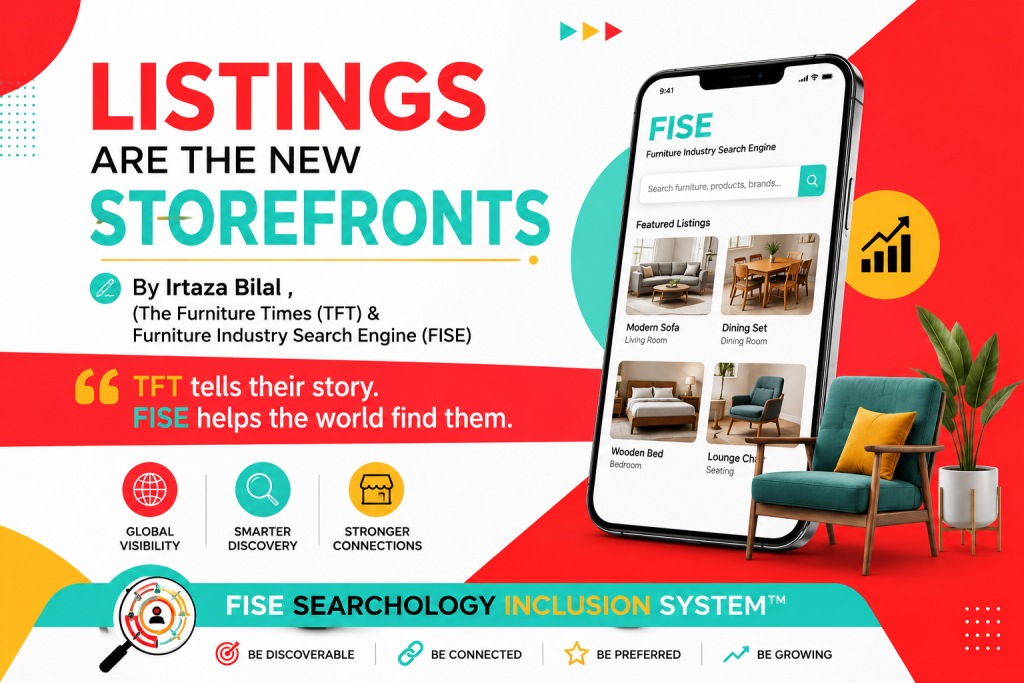
TFT tells their story. FISE helps the world find them.
There was a time when having a storefront meant having a physical address.
A beautiful signboard.
A display window.
A location where customers could walk in, look around, ask questions, compare products and decide whether they trusted you enough to buy.
Today, the storefront has moved.
It is no longer limited to a street, shopping mall, showroom or exhibition hall.
Your digital listing can be your storefront. Your search presence can be your location. Your profile can be your first impression. And your discoverability can determine whether the world ever knows you exist.
This is the uncomfortable reality that millions of small businesses, furniture manufacturers, artisans, independent makers, workshops, designers, entrepreneurs and grassroots creators need to confront.
Being good is no longer enough if nobody can find you.
You can make exceptional furniture and remain invisible.
You can create extraordinary handcrafted products and remain undiscovered.
You can operate a family business for three generations and still have almost no digital footprint.
You can have a remarkable story, incredible craftsmanship and loyal local customers, yet lose opportunities every day because your business does not exist where modern discovery happens.
That is why listings are becoming the new storefronts.
And this is where The Furniture Times (TFT) and Furniture Industry Search Engine (FISE) enter a much bigger conversation.
TFT tells their story.
FISE helps the world find them.
Together, they represent a different way of thinking about digital visibility: one that is not simply about advertising, but about identity, discovery, opportunity, livelihood and human impact.
At the centre of this movement is FISE Searchology Inclusion System™, designed as a global visibility engine for SMEs, artisans, makers and grassroots creators.
This is not just another business listing system.
It is a livelihood system.
A human impact system.
A search revolution.
A digital identity movement.
A global opportunity engine.
And the urgency is growing.
Because the businesses that build their digital identity today may be the businesses that get discovered tomorrow.
The Storefront Has Changed Forever
Think about how customers discover businesses today.
They search.
They compare.
They investigate.
They read profiles.
They look at images.
They check locations.
They explore websites.
They search names.
They ask AI systems.
They look for recommendations.
They browse marketplaces and directories.
They check social platforms.
They search by product, category, location, material, capability and purpose.
Before they ever contact a company, they may already have formed an opinion about it.
Your business may be making its first impression before you even know the customer exists.
That changes everything.
In the traditional economy, your storefront worked because people could physically see it.
In the digital economy, your listing has to perform the same function.
It must tell people:
Who are you?
What do you make?
What do you offer?
Where are you located?
What makes you different?
Why should someone trust you?
How can they contact you?
What markets do you serve?
What is your story?
What capabilities do you have?
What products or services can you provide?
And perhaps the most important question:
Can the right people actually find you?
A weak digital presence creates friction.
A strong digital presence creates possibility.
A Great Business Can Still Be Invisible
One of the biggest misconceptions in modern business is that quality automatically creates visibility.
It does not.
Quality creates value.
Visibility creates discovery.
Discovery creates conversations.
Conversations can create opportunities.
Opportunities can create revenue.
Revenue can support livelihoods.
And livelihoods can strengthen families, communities and entire local economies.
That chain matters.
Imagine a small furniture workshop producing beautiful handcrafted chairs.
The craftsmanship is exceptional.
The workers are skilled.
The materials are carefully selected.
The owner has spent decades learning the trade.
The products could potentially serve hotels, restaurants, interior designers, architects, retailers and international buyers.
But there is one problem.
Nobody outside the local area knows the workshop exists.
That business does not necessarily have a quality problem.
It has a visibility problem.
Now imagine an artisan producing handmade furniture in a small community.
The products are distinctive.
The story is powerful.
The craftsmanship cannot easily be replicated by mass production.
But when someone searches for handcrafted furniture, sustainable furniture, artisan furniture or a particular product category, the maker does not appear.
The world cannot discover what the search system cannot effectively surface.
This is the gap FISE is designed to address.
Listings Are No Longer Just Information
A traditional directory might simply provide a company name, phone number and address.
That approach belongs to an earlier era.
Modern listings can become much more powerful.
A meaningful business listing can become a digital identity layer.
It can connect a business with:
Its name.
Its location.
Its products.
Its services.
Its capabilities.
Its industry.
Its story.
Its audience.
Its markets.
Its people.
Its credibility.
Its digital footprint.
And when these elements are structured intelligently, the listing can become more than a static page.
It can become a gateway to discovery.
That is the fundamental idea behind the new generation of business visibility.
The listing is no longer the end of the journey. It can become the beginning.
The Furniture Industry Needs a Visibility Revolution
The furniture industry is a perfect example.
Across the world, there are enormous numbers of manufacturers, exporters, workshops, suppliers, designers, craftsmen, retailers, material specialists and independent makers.
Some operate massive factories.
Others work from small studios.
Some serve international hotel chains.
Others create furniture for their local communities.
Some specialize in outdoor furniture.
Others focus on luxury interiors.
Some produce traditional handcrafted pieces.
Others manufacture modern contemporary designs.
Some work with wood.
Others specialize in metal, rattan, wicker, upholstery, recycled materials, composites or innovative materials.
The diversity is extraordinary.
But discovery remains fragmented.
A buyer may know what they need without knowing who can provide it.
An architect may be searching for a specialist manufacturer.
A hotel procurement team may need a reliable furniture supplier.
An interior designer may want an artisan capable of producing a custom piece.
An international distributor may be looking for manufacturers in a specific country.
A consumer may want a local furniture maker.
A small business may want international exposure but lack the resources to build a massive marketing department.
This is where structured discoverability becomes important.
FISE is built around the idea that businesses should have a better opportunity to be found.
FISE: Helping the World Find Them
The Furniture Times tells their story.
Stories matter because businesses are not simply collections of products.
Behind every workshop is a person.
Behind every factory is a team.
Behind every handcrafted product is a maker.
Behind every family business is a history.
Behind every entrepreneur is a risk.
Behind every small business is often a dream that required years of sacrifice.
TFT can provide the storytelling layer.
But storytelling alone is not enough.
A story needs an audience.
That is where FISE helps the world find them.
FISE represents the discovery layer.
The objective is simple but powerful:
Connect businesses with the digital discovery ecosystem so that the right people have a better chance of finding the right businesses.
This is especially important for SMEs and independent creators that do not have the budgets of global corporations.
Because the digital economy should not belong exclusively to the companies with the biggest advertising budgets.
Visibility should also create room for the small, the skilled, the local, the independent and the emerging.
FISE Searchology Inclusion System™: More Than a Listing
The phrase Searchology Inclusion System™ represents a broader philosophy.
Search is changing.
Discovery is changing.
Artificial intelligence is changing.
Consumer behaviour is changing.
Business buying behaviour is changing.
The old question was:
“Do you have a website?”
The new question is:
“Can people and discovery systems understand who you are, what you do and why you matter?”
That distinction is enormous.
A business can technically have a website and still be difficult to discover.
A business can have social media accounts and still lack a coherent digital identity.
A business can advertise aggressively and still struggle to build lasting discoverability.
The future belongs to businesses that make themselves understandable across the digital ecosystem.
That requires structured information, credible identity, relevant categorisation, clear descriptions, useful content, discoverable products and consistent digital signals.
This is where a system such as FISE can become strategically important.
FISE Searchology Inclusion System™ is not simply about putting a business into a database.
It is about thinking differently about inclusion in the modern discovery economy.
Why Digital Identity Is Becoming a Business Asset
For decades, companies invested in physical assets.
Factories.
Warehouses.
Showrooms.
Vehicles.
Machines.
Equipment.
Inventory.
Today, businesses must also think about digital assets.
Domains.
Profiles.
Listings.
Business information.
Product pages.
Content.
Reviews.
Images.
Brand mentions.
Structured data.
Industry profiles.
Search visibility.
Digital reputation.
These assets may not occupy physical space, but they influence how a company is discovered and evaluated.
Digital identity is becoming part of business infrastructure.
A company without a coherent digital identity can be like a beautifully designed showroom hidden behind an invisible wall.
The products may be there.
The people may be there.
The capability may be there.
But the customer cannot find the door.
The Real Cost of Being Invisible
Business owners often think about the cost of marketing.
But they should also think about the cost of invisibility.
What happens when a buyer searches for your product and finds your competitor instead?
What happens when an architect needs your capability but discovers another supplier?
What happens when an international customer wants your product but cannot verify your business?
What happens when a potential partner searches for your company and finds almost nothing?
What happens when your competitors appear repeatedly while your business remains absent?
These are not theoretical questions.
Every missed discovery can become a missed opportunity.
The cost of invisibility may include:
Lost leads.
Lost partnerships.
Lost export opportunities.
Lost brand recognition.
Lost customer trust.
Lost supplier relationships.
Lost recruitment opportunities.
Lost media exposure.
Lost market access.
And for smaller businesses, the consequences can be significant.
Because one meaningful contract can change a small company’s trajectory.
One international buyer can create jobs.
One hospitality project can keep a workshop busy for months.
One distributor can open a new market.
One strategic partnership can transform a local maker into an international brand.
Visibility can have economic consequences far beyond a website visit.
From Search Visibility to Human Impact
This is why the FISE concept goes beyond conventional marketing.
Consider a small artisan business.
More visibility can mean more enquiries.
More enquiries can mean more orders.
More orders can mean more production.
More production can mean more employment.
More employment can mean greater household income.
Greater household income can support education, housing, healthcare, local commerce and community development.
This is why calling FISE a livelihood system is not merely a marketing phrase.
The underlying idea is that digital discovery can have a human economic impact.
A business listing may look like a simple digital page.
But behind that page can be a family.
Behind that family can be a community.
Behind that community can be a local economy.
The digital world can influence the physical world.
A Search Revolution for the Businesses That Built the Real Economy
Large corporations have entire teams dedicated to digital visibility.
They have SEO departments.
Content teams.
Public relations teams.
Advertising budgets.
Technology departments.
Brand strategists.
Data analysts.
They can build sophisticated digital ecosystems.
But what about the small furniture maker?
The independent artisan?
The family-owned manufacturer?
The rural workshop?
The grassroots creator?
The emerging designer?
The SME that is excellent at manufacturing but has never had a dedicated digital marketing team?
These businesses should not be automatically excluded from digital discovery.
The next search revolution must include them.
That is the opportunity FISE is trying to address.
Not by telling every business to become a technology company.
But by helping businesses establish a meaningful digital presence within their industry ecosystem.
FISE LIVE: Turning Visibility Into a Living Experience
The idea of FISE LIVE adds another dimension to this movement.
Businesses are not static.
Markets change.
Products evolve.
New makers emerge.
New manufacturers enter industries.
New capabilities become available.
New opportunities appear.
A living industry ecosystem therefore needs more than static information.
It needs activity.
Discovery.
Connection.
Stories.
Updates.
Participation.
Visibility.
FISE LIVE represents the idea of an active, living discovery environment rather than a forgotten directory.
For businesses, this can create opportunities to remain present.
For buyers, it can make discovery more dynamic.
For industries, it can create a stronger sense of ecosystem.
And for emerging businesses, participation can become an opportunity to step into the global conversation.
The Future Buyer Will Search Differently
The next generation of buyers will not necessarily behave like buyers of the past.
Search is becoming conversational.
People ask questions rather than simply entering keywords.
They may ask:
“Who makes sustainable outdoor furniture in this region?”
“Which manufacturers can produce custom hotel furniture?”
“Where can I find handcrafted rattan furniture?”
“Which furniture companies specialise in hospitality projects?”
“Who are the leading artisan furniture makers in this country?”
“Which suppliers can handle international orders?”
The more intelligent search becomes, the more important business information becomes.
If a business cannot clearly communicate what it does, where it operates, what it makes and whom it serves, discovery becomes harder.
Businesses need to become machine-understandable without losing their human identity.
That is one of the most important challenges of the emerging digital economy.
AI Is Changing Discovery. Businesses Must Change With It.
Artificial intelligence is rapidly changing how people discover information.
Search engines are evolving.
AI assistants are becoming part of research.
Recommendation systems are becoming more sophisticated.
People increasingly expect direct answers.
That means businesses cannot depend exclusively on traditional keyword tactics.
They need meaningful information.
Clear identity.
Strong descriptions.
Relevant categories.
Useful content.
Credible signals.
Consistent information.
Real-world expertise.
Industry relevance.
And a story that humans can understand.
The future is not simply about ranking for a keyword.
It is about becoming an answer.
When someone asks a question related to your industry, your business should have enough digital substance to be considered relevant.
That is the larger opportunity behind modern search visibility.
Why SMEs Cannot Afford to Wait
There is a dangerous tendency among small businesses to postpone digital investment.
“I will do it later.”
“When sales improve.”
“When we have a bigger budget.”
“When we hire someone.”
“When the business grows.”
But digital identity does not work like a switch that suddenly becomes important after a company becomes successful.
It is part of how success can be built.
The business that starts building visibility today may have years of accumulated digital presence when the next major opportunity arrives.
The business that waits may have to start from zero.
That is why the urgency is real.
Do not wait until your competitor becomes the business your customer discovers first.
The New Competition Is Not Just Price
For years, businesses competed on:
Price.
Quality.
Location.
Delivery.
Service.
Design.
Capacity.
Today, they increasingly compete on something else:
Discoverability.
Two companies may offer similar products.
One is easy to find.
The other is almost invisible.
The first company can receive more enquiries simply because it entered the customer’s consideration set earlier.
This does not mean visibility replaces quality.
It means quality needs visibility to reach the market.
The greatest product in the world cannot create a customer relationship with someone who never discovers it.
Listings Can Become Trust Infrastructure
A good business listing can also contribute to trust.
Customers want to know that a company is real.
Buyers want to know what it does.
Partners want to understand its capabilities.
International clients want confidence.
A structured profile can provide important context.
Who is behind the business?
What does it manufacture?
Where is it located?
What categories does it serve?
What markets does it operate in?
What is its story?
What products does it offer?
How can someone contact it?
These details reduce uncertainty.
Trust grows when uncertainty falls.
A meaningful digital identity can therefore become part of the trust-building process.
The Human Being Behind the Business
There is another reason this movement matters.
Digital platforms often reduce businesses to data.
Company name.
Category.
Address.
Phone number.
Website.
But a business is more than data.
There is a person behind it.
There is effort.
There is history.
There is ambition.
There are failures.
There are sacrifices.
There are employees.
There are families.
There are communities.
There is craftsmanship.
There is pride.
There is hope.
That is why TFT tells their story.
A business should not disappear behind a search result.
Its story should have a place.
Its identity should have a place.
Its work should have a place.
Its people should have a place.
And its opportunities should have a chance to find it.
From Local Workshop to Global Opportunity
Imagine a small artisan workshop that has spent twenty years mastering a traditional craft.
Its products are exceptional.
Its customers love them.
But its market is limited.
Now imagine that workshop develops a structured digital identity.
Its capabilities are clearly described.
Its products are visible.
Its location is clear.
Its story is documented.
Its industry category is accurate.
Its profile becomes discoverable.
Its presence connects with relevant buyers and audiences.
Suddenly, the workshop has a chance to be considered by people who previously had no idea it existed.
That does not guarantee success.
But it changes the opportunity.
And sometimes opportunity is the first thing a small business needs.
The Global Opportunity Engine
Calling FISE a global opportunity engine reflects a fundamental belief:
Geography should not always determine discoverability.
A business may be small geographically but enormous in capability.
A maker may work from a remote community but produce globally relevant products.
An entrepreneur may operate with ten employees but have the capacity to serve international customers.
A grassroots creator may have no global advertising budget but possess a unique product and powerful story.
Digital visibility can help reduce the distance between capability and opportunity.
That is powerful.
Because the internet was supposed to make the world more connected.
Now the challenge is making sure the right businesses are actually visible within that connected world.
What Businesses Should Do Now
The future of visibility is not something businesses should simply discuss.
They should act.
Start with your digital identity.
Search your own company name.
What appears?
Is your business information accurate?
Can customers understand what you do within seconds?
Are your products clearly presented?
Can buyers identify your location?
Does your profile communicate your capabilities?
Does your online presence tell your story?
Are you represented in the industry ecosystems where buyers search?
Are you discoverable beyond social media?
Can an AI system understand what your business does?
Can a potential international buyer verify that you exist?
If the answer to these questions is no, your digital storefront needs work.
The 10-Step Digital Storefront Wake-Up Call
1. Search Your Own Business
Do not assume customers see what you see.
Search your company name.
Search your products.
Search your services.
Search your industry category.
Search your location plus your product.
Then ask:
Would I trust this business if I discovered it today?
2. Claim Your Digital Identity
Your business name should be represented consistently across relevant platforms.
Inconsistent names, outdated information and incomplete profiles can create confusion.
Your digital identity should be clear.
3. Tell Your Story
Do not write a generic company description that could belong to any competitor.
Explain why you exist.
Explain what you make.
Explain what makes your approach different.
Explain the people behind the business.
Your story is part of your competitive advantage.
4. Showcase Capabilities, Not Just Products
Buyers often search for capabilities.
Can you manufacture custom furniture?
Can you produce hospitality quantities?
Can you handle exports?
Can you work with specific materials?
Can you create bespoke designs?
Can you meet particular project requirements?
Tell the market what you can actually do.
5. Make Your Products Discoverable
A product buried inside a social media feed is difficult to discover months later.
Build lasting digital visibility around your products.
Use descriptive names.
Explain materials.
Explain applications.
Explain industries served.
Explain relevant specifications.
Make discovery easier.
6. Build Industry Relevance
A business should not exist digitally in isolation.
Industry ecosystems matter.
Relevant directories, platforms, publications, communities and search environments can strengthen discovery.
This is where specialised systems such as FISE become particularly important.
7. Use Visual Storytelling
Furniture is visual.
Design is visual.
Craftsmanship is visual.
Manufacturing is visual.
Use high-quality photographs that show more than the finished product.
Show details.
Materials.
Craftsmanship.
Workspaces.
Production.
People.
Projects.
Because customers often want to understand not only what you sell, but how you create it.
8. Make Contact Easy
Visibility without a path to action is wasted opportunity.
Your listing should make it easy for people to understand how to contact you.
Do not make potential customers search for basic information.
Reduce friction.
9. Keep Information Fresh
An outdated listing can damage trust.
Update products.
Update contact information.
Update capabilities.
Add new projects.
Add new stories.
Keep your digital storefront alive.
10. Stop Thinking Like a Directory Entry
This may be the most important step.
Your listing is not merely an entry.
It is part of your digital storefront.
Treat it accordingly.
Invest in it.
Write it properly.
Present it professionally.
Update it.
Build around it.
Connect it with your broader digital identity.
And most importantly:
Make it discoverable.
The Furniture Times and FISE: Story Meets Discovery
There is a powerful relationship between storytelling and search.
TFT can tell the story.
FISE can help people discover the business.
One gives context.
The other creates discoverability.
One humanises.
The other connects.
One helps people understand why the business matters.
The other helps them find where that business exists within the digital ecosystem.
Story without discovery can remain unseen.
Discovery without story can remain forgettable.
The combination is powerful.
This Is Bigger Than Furniture
Although FISE is deeply connected to the furniture industry, the underlying principle extends far beyond furniture.
Think about:
Textile makers.
Jewellery artisans.
Craft producers.
Home décor businesses.
Independent designers.
Food producers.
Small manufacturers.
Local workshops.
Creative entrepreneurs.
Grassroots creators.
Specialist suppliers.
Family-owned enterprises.
Emerging brands.
Across industries, the same problem exists.
Great businesses are often hidden in plain sight.
The world does not need fewer talented people.
It needs better ways to discover them.
Inclusion Is the Bigger Mission
The word inclusion matters.
Because the digital economy can easily become concentrated.
Businesses with money can buy attention.
Large brands can dominate advertising.
Established companies can hire experts.
But SMEs, artisans and grassroots creators often have something that money cannot manufacture:
Authenticity.
Craftsmanship.
Originality.
Local knowledge.
Cultural heritage.
Human stories.
The challenge is helping those qualities become visible.
That is where a global visibility engine can create meaningful change.
Inclusion means creating more doors to discovery.
The Next Generation of Entrepreneurs Will Think Differently
Tomorrow’s entrepreneur may not ask:
“Where should I rent my first showroom?”
They may ask:
“Where should my business be discoverable?”
They may think about digital identity from day one.
They may build their company around discoverability.
They may understand that every profile, listing, article, product page, project and story contributes to their digital presence.
They may understand that search is not just a marketing channel.
Search is infrastructure.
And the companies that understand that early may have an enormous advantage.
The Urgency Is Not Tomorrow
The urgency is today.
Every day your business remains difficult to discover, someone else is easier to find.
Every day your story remains undocumented, another company can dominate the conversation.
Every day your capabilities remain hidden, opportunities may pass elsewhere.
Every day your digital identity remains incomplete, potential customers may hesitate.
The internet does not wait for businesses to become ready.
Search does not wait.
Customers do not wait.
Buyers do not wait.
Markets do not wait.
The businesses that take visibility seriously today will be better positioned for the opportunities of tomorrow.
From Storefronts to Searchfronts
The traditional storefront had a simple purpose:
Get people through the door.
The modern digital storefront has the same purpose, but the door is invisible.
It exists inside search.
Inside discovery.
Inside recommendations.
Inside digital ecosystems.
Inside AI-powered answers.
Inside industry platforms.
Inside business listings.
Inside content.
Inside digital identity.
The new storefront is everywhere your potential customer might discover you.
That means businesses must stop asking only:
“Do we have a website?”
They must start asking:
“Can the world find us?”
And then:
“When the world finds us, will it understand why we matter?”
FISE LIVE and the Future of Industry Discovery
The future will belong to ecosystems that are active, connected and discoverable.
FISE LIVE points toward this direction.
An industry should not merely be a collection of companies.
It can become an ecosystem where:
Businesses discover buyers.
Buyers discover manufacturers.
Designers discover artisans.
Architects discover suppliers.
Retailers discover brands.
Entrepreneurs discover partners.
Creators discover audiences.
And opportunities move across borders.
That is what makes a platform more powerful than a static directory.
A directory tells you who exists.
An ecosystem helps you discover what is possible.
Your Business Deserves to Be Found
Every entrepreneur should ask one uncomfortable question:
If someone is actively looking for exactly what I offer today, can they find me?
If the answer is uncertain, do not ignore it.
Do not wait for the market to solve it for you.
Do not assume social media alone is enough.
Do not assume your reputation in your local community automatically translates into digital discoverability.
Do not assume having a website means having visibility.
And do not assume being excellent guarantees being discovered.
Build your digital storefront.
Build your digital identity.
Build your discoverability.
Tell your story.
Make your capabilities visible.
Give opportunity a way to find you.
The Future Belongs to the Discoverable
The next era of business will not simply reward the companies that make the best products.
It will increasingly reward companies that can communicate their value clearly and become discoverable in the places where decisions are being made.
That does not diminish craftsmanship.
It protects it.
It does not replace human stories.
It amplifies them.
It does not make small businesses less important.
It gives them another chance to be seen.
And that is why the concept behind FISE Searchology Inclusion System™ matters.
Because this is not merely about listings.
It is about who gets seen.
Who gets discovered.
Who gets a chance.
Who gets connected.
Who gets an opportunity.
Who gets to take a local capability and introduce it to a global audience.
That is the real promise of digital visibility.
The Final Wake-Up Call
The world is full of businesses waiting to be discovered.
A furniture maker with decades of expertise.
An artisan preserving a traditional craft.
A small manufacturer capable of serving international projects.
A young entrepreneur building something from nothing.
A grassroots creator with an idea nobody has seen before.
A family business carrying its legacy into a new generation.
Their biggest problem may not be talent.
It may not be quality.
It may not be ambition.
It may simply be that the world cannot find them yet.
That has to change.
Listings are becoming the new storefronts.
Digital identity is becoming a business asset.
Search is becoming a gateway to opportunity.
And platforms such as FISE can help create a more connected discovery environment for the businesses, makers and creators that deserve to be seen.
TFT tells their story.
FISE helps the world find them.
And through FISE LIVE and the FISE Searchology Inclusion System™, the bigger mission is clear:
Turn visibility into opportunity.
Turn discovery into connection.
Turn digital identity into possibility.
Turn search into inclusion.
Turn business visibility into human impact.
Because the future should not belong only to the biggest brands.
It should also belong to the businesses that have something extraordinary to offer but have never had a fair chance to be discovered.
The storefront has changed.
The question is no longer whether your business has a door.
The question is whether the world can find it.
Take Action Today
For SMEs: Stop treating your digital presence as an afterthought. Build an identity that makes your business understandable and discoverable.
For artisans: Your craftsmanship deserves more than word of mouth. Put your story, skills and products where new audiences can find them.
For manufacturers: Make your capabilities visible to buyers who may be searching for exactly what you produce.
For furniture brands: Treat your digital listing as a showroom that works even when your physical showroom is closed.
For grassroots creators: Do not underestimate the value of being digitally discoverable. Your next opportunity may come from someone who has never heard of you.
For industry leaders: Support ecosystems that make discovery more inclusive.
For every entrepreneur: Ask yourself today, not next year: Can the right people find my business?
If the answer is no, your next business investment may not be another advertisement.
It may be visibility.